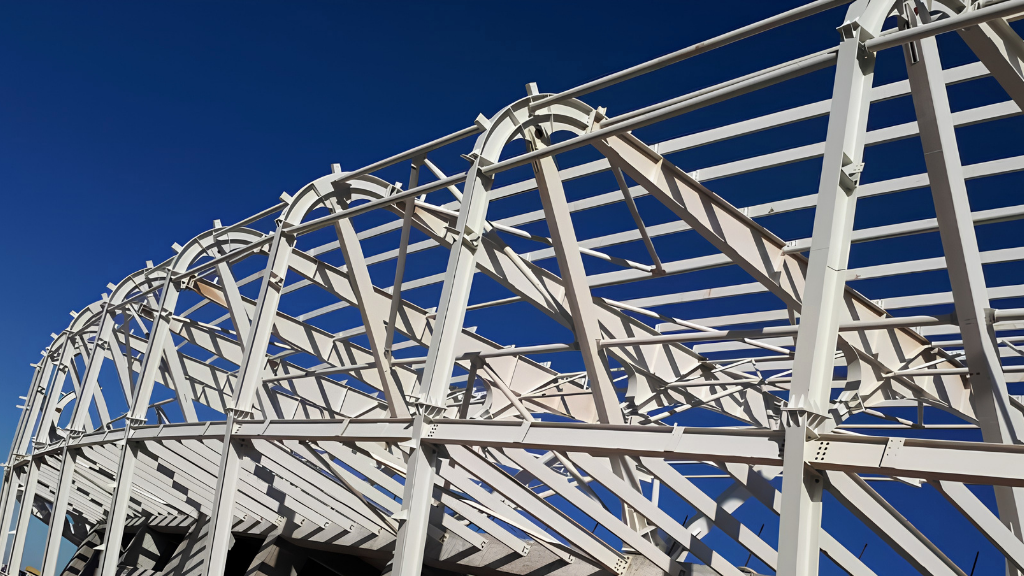
Long-span steel structures exceeding 40 metres differ fundamentally from conventional buildings in terms of structural behaviour, thermal expansion, and erection precision. In this article, we examine design limits, site-specific application risks, and BIM-driven digital solutions through a technical lens — within the framework of Eurocode 3 and AISC standards.
Modern architectural demands and large-scale industrial operations have placed the concept of Long-Span Structures — column-free interior spaces spanning vast distances — at the heart of structural engineering. Yet these extraordinary spans introduce complex structural behaviours, difficult-to-control mechanical variables, and elevated erection risks that require a disciplined, systematic approach.
1. Structural Design and Engineering Limits
Designing long-span systems goes well beyond standard structural analysis. It demands the management of Second-Order Effects and non-linear behaviours that standard frameworks alone cannot address. This complexity forces engineers to make critical decisions at both the material and geometric level.
Self-Weight and Load Distribution
As span length increases, the structure’s self-weight increasingly dominates over imposed loads such as snow and wind. Eurocode 3 (EN 1993-1-1) standards identify the use of high-strength steel grades (S355 and above) and the optimisation of the weight-to-capacity ratio as critical parameters for such structures. Errors in load distribution can lead to cumulative deformations and structural fatigue over time. Technical analyses on load distribution and material selection in long-span systems highlight the importance of correctly establishing these parameters at the outset of a project.
Thermal Expansion and Differential Movements
Individual steel members exceeding 100 metres in length are extremely sensitive to temperature fluctuations. AISC technical guides emphasise that the secondary stresses induced by this expansion at structural connections must be dissipated through specially designed sliding bearing details. Neglected thermal movements can result in fatigue cracks at connections and separation at welded joints.
2. Critical Challenges During Erection and Construction
Transferring a design from paper to site without error is the highest-risk phase of any long-span project. Throughout this process, the structural system, logistical constraints, and workmanship precision must be managed simultaneously.
Time-Dependent Mechanical Changes
During erection, the structural system changes continuously as the structure remains incomplete. Technical analyses published by MDPI (Sustainability Journal) have demonstrated that millimetre-level deviations at lifting points during Integral Lifting operations can result in permanent structural damage. For this reason, the lifting plan must be supported by a dynamic structural model that encompasses all stages of the erection sequence.
Precision Tolerance Management
In steel construction, the alignment between fabrication tolerances and site erection tolerances is essential. The Camber (pre-cambering) technique applied during the erection of large-span beams requires mathematical precision to ensure the structure settles at its intended elevation under service loads. Incorrect camber values lead to visual and structural deformation issues during occupancy.
3. Digital Transformation: BIM and Decision Support Systems
In the design and execution of long-span structures, traditional methods are increasingly inadequate in the face of growing complexity. The integration of digital tools is no longer a preference — it is a competitive necessity.
BIM (Building Information Modelling) Integration
Digital twins created during the design phase reduce clashes during erection (clash detection) by up to 20%, while simultaneously minimising material waste. BIM models also allow the simulation of structural changes during erection; critical operations such as Integral Lifting can therefore be rehearsed digitally before being carried out on site.
LiDAR and Laser Scanning
Laser scanning carried out on site at each stage of erection compares the theoretical model with the as-built condition, aiming to minimise the margin of error. For long-span roof systems in particular, early detection of deviations between beam axes prevents costly remedial operations later in the programme.
Check out our references.
Conclusion
Long-span steel structures represent a field where engineering must unite not only strength and durability, but also precision and logistical discipline. Rigorous design compliant with international standards (Eurocode 3, AISC), when supported by BIM integration, laser scanning, and meticulous tolerance management, becomes the single defining factor that ensures these extraordinary structures are both safe and sustainable.